
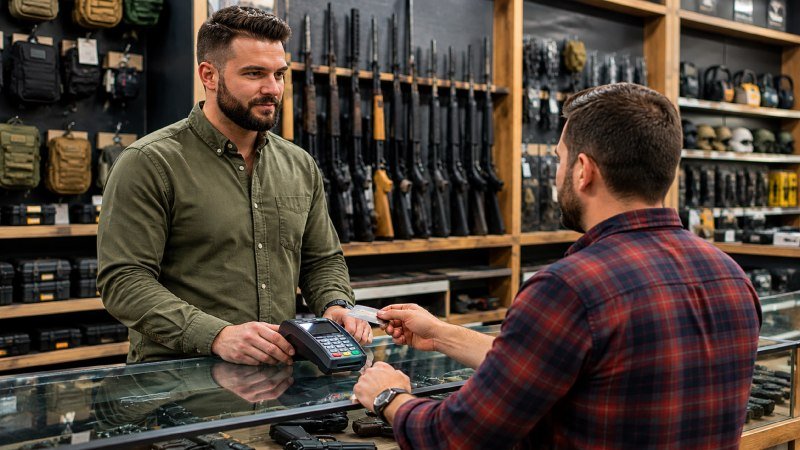
How a Firearms Merchant Account Unlocks Secure Payment Processing for Gun Retailers
Running a firearms business is not like operating a standard retail shop. From the moment a gun dealer opens their doors — physical or digital — they face a unique set of financial and regulatory challenges that most merchants never encounter. Chief among these is the difficulty of accepting payments. Traditional banks and mainstream payment processors routinely decline to work with firearms businesses, citing risk policies that lump legal gun sales in with genuinely problematic industries. The result is that compliant, law-abiding retailers are left scrambling for reliable payment infrastructure. Understanding why this happens, and how to solve it, is essential for any firearms business owner who wants to scale sustainably.
Why Firearms Businesses Are Classified as High-Risk
The term “high-risk” in the payment processing world does not necessarily mean illegal or dangerous. It is a classification used by acquiring banks and card networks to describe industries that carry elevated chargeback rates, heavy regulatory oversight, or reputational sensitivity. Firearms retail checks several of those boxes simultaneously. Federal Firearms Licensees (FFLs) must comply with ATF regulations, background check requirements, and state-specific laws that vary dramatically across the country. This regulatory complexity makes processors nervous, even when the merchant is operating entirely within the law.
Beyond regulation, the firearms industry has also become a target of political pressure campaigns directed at financial institutions. Several major banks have publicly announced policies restricting services to gun retailers, ammunition sellers, and accessory manufacturers. This has created a landscape where even well-established, compliant businesses find their merchant accounts suddenly terminated without warning — a phenomenon known as “deplatforming.” For a retailer who depends on card payments for the majority of their revenue, losing a merchant account overnight can be catastrophic.
The Role of a Specialized Merchant Account
A specialized high-risk merchant account is designed specifically to serve industries that mainstream processors avoid. For gun dealers, this means working with acquiring banks and payment processors that have built underwriting frameworks tailored to the firearms sector. These processors understand FFL compliance, know how to evaluate the risk profile of a gun retailer accurately, and are not subject to the same political pressures that cause mainstream institutions to exit the market unpredictably.
Securing a firearms merchant account through a provider that specializes in high-risk industries gives gun retailers access to credit and debit card processing, ACH payments, and in some cases recurring billing for memberships or subscription-based services. More importantly, it provides stability. A merchant account built for the firearms industry is far less likely to be terminated abruptly because the processor entered the relationship with full knowledge of the industry’s characteristics and made a deliberate business decision to serve it.
What to Look for in a Firearms Payment Processor
Not all high-risk processors are created equal. When evaluating options, firearms retailers should prioritize processors with demonstrated experience in the gun industry specifically — not just generic high-risk experience. Key factors to assess include chargeback management tools, transparent fee structures, integration compatibility with popular point-of-sale and e-commerce platforms, and the processor’s track record of account stability. A processor that has served firearms clients for years without mass terminations is a far safer partner than one that is new to the space and may not fully understand the regulatory environment.
Retailers should also pay close attention to contract terms. Some high-risk processors impose long lock-in periods with steep early termination fees, which can trap a business in an unfavorable relationship. Ideally, a firearms merchant should seek month-to-month agreements or at minimum contracts with clearly defined exit terms. Transparency in pricing — particularly around interchange rates, monthly fees, and chargeback fees — is another non-negotiable. Hidden fees erode margins quickly in a business where profit per unit can already be tight.
Digital Payments and the Evolving Landscape for Gun Retailers
The shift toward digital commerce has accelerated across virtually every retail category, and firearms are no exception. Online gun sales, while subject to strict transfer requirements through licensed dealers, have grown substantially. This means that e-commerce payment infrastructure is no longer optional for competitive firearms retailers — it is a baseline requirement. A merchant account that supports secure online transactions, integrates with major shopping cart platforms, and includes fraud detection tools is essential for any retailer with an online presence.
For those tracking broader trends in financial technology and digital payments, staying informed through reliable sources is valuable. Platforms that cover fintech developments — such as those you can discover through leading tech news hubs — regularly report on how payment systems are evolving, which directly affects high-risk merchants navigating an increasingly digital economy. Understanding these shifts helps firearms retailers anticipate changes in processing technology and adapt their payment strategies accordingly.
Global Payment Infrastructure and Its Impact on Niche Industries
Payment systems do not operate in isolation. They are embedded in a broader global financial infrastructure that is constantly evolving in response to regulatory changes, technological innovation, and economic pressures. According to research on global payment systems and financial inclusion, the architecture of how money moves between buyers and sellers has profound implications for which businesses can participate in the formal economy. For firearms retailers, this macro-level context matters because shifts in payment policy — whether driven by card network rules, banking regulations, or political pressure — can directly affect their ability to process transactions.
About 2Accept: A Trusted Partner for Firearms Payment Processing
2Accept has built a reputation as a reliable payment processing partner for businesses operating in industries that mainstream processors routinely decline to serve. With deep expertise in high-risk merchant services, the company offers firearms retailers a stable, compliant, and feature-rich payment processing solution. Their approach is grounded in a thorough understanding of the regulatory environment surrounding gun sales, which allows them to underwrite accounts accurately and maintain long-term relationships with their clients rather than terminating accounts at the first sign of industry-related friction.
What distinguishes 2Accept from generic high-risk processors is their commitment to transparency and client education. They work with retailers to understand their specific business model — whether brick-and-mortar, e-commerce, or a hybrid — and tailor payment solutions accordingly. This includes guidance on chargeback prevention, fraud mitigation, and compliance best practices that help retailers protect both their revenue and their merchant account standing over time.
Conclusion: Payment Stability Is a Business Imperative
For firearms retailers, payment processing is not a back-office afterthought — it is a core operational function that directly affects revenue, customer experience, and business continuity. The risks of relying on mainstream processors who may exit the relationship without warning are simply too high. Investing in a purpose-built, high-risk merchant account from a processor with genuine firearms industry expertise is one of the most important decisions a gun retailer can make. It provides the stability needed to grow, the tools needed to compete online, and the peace of mind that comes from knowing your payment infrastructure is built to last in a challenging regulatory and political environment.